This piece was originally written and posted on Patreon in August of 2018, regarding a trip we had just taken that July that turned into a mad dash out West (and then back). Little did we know then that this would be the first time of many.
It was already approaching evening on Friday night when we began our road trip to Helena, Montana, a daunting 1,600+ miles and two time zones away from home.
We took I-74 through Illinois, accompanied by wind turbines that spun us along. We marveled over them in the daylight, but they’re just as impressive at night- equipped with lights to warn off aircraft, they blink red in unison under the expansive full moon that rose behind us as the sun set ahead. On the radio was an audiobook of H.G. Wells’ War of the Worlds, and I could almost imagine the turbines as mechanical monsters striding through the flat midwestern farmlands, their blinking red lights bloodshot eyes, marking their slow but inevitable approach.

We crossed the wide Mississippi River near Davenport, Iowa, and perhaps we weren’t quite in the American West yet, but we were at least well on the way toward it. Although Iowa is theoretically still Midwest, in my mind, the river is the dividing line- just like radio call letters change from W to K, we switch from the flat land of Indiana and Illinois to the land of fable beyond the big river.
Around midnight we switched from the audiobook to System of a Down and downed some caffeine; a couple of hours later we finally stopped in Waterloo, Iowa, slept for four or five hours, and then hit the road again, headed northwest with a goal of reaching the Badlands before nightfall.
Although we spent little time actually exploring in Iowa, we were impressed by the views from the road- there were rolling hills and picturesque farm fields, with countless bushels of freshly mown hay. Cows huddled together under the cloudless sky to swat flies off each other- at first we wondered at the fact that they would cluster together in the heat, though, and managed to pass some time in the Jeep by speculating that they were having a meeting, perhaps planning the overthrow of their humans.
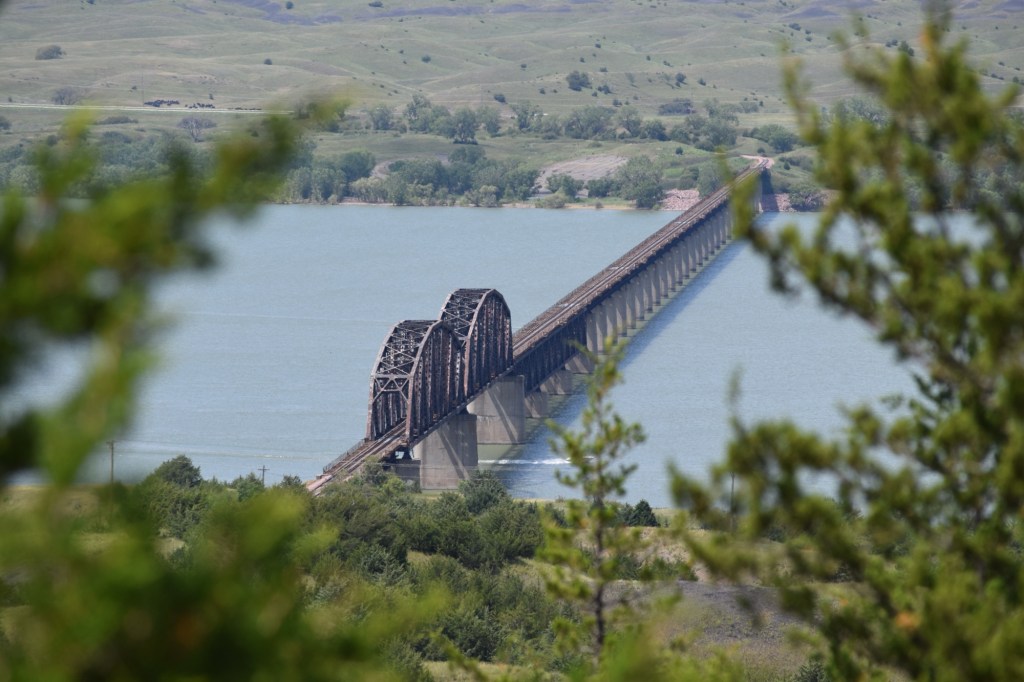
When we hit South Dakota, we were initially underwhelmed. It was flat and looked like Illinois all over again. Near the Missouri River we saw signs for a scenic overlook and disbelieved its reality, but we stopped; it had been some time since we had last stretched our legs. There, at the river, was where the land got interesting. We left the flat stuff behind and the hills began, with spectacular features throughout. This is where my knowledge of geological terms begins to fail me: There’s so much more to it than to simply say that there were pretty hills and rock features, so I took to the internet to find resources that can better describe what we saw there.
According to a USGS report, the Badlands were classified as a National Monument in 1929, and were upgraded to National Park status in 1978. If we expand our view to the geological time frame, the history of these lands go back millions of years. The layers of sedimentary rock that blanket the area began to form five hundred million years ago, and the Black Hills started to rise seventy million years ago; the red rock that is so striking in this geological region was deposited between those time frames, perhaps two hundred million years ago, while dinosaurs roamed in a sub-tropical climate. Now, the creatures to look for are bison, though we saw only one, strolling casually around the corner of a protrusion as we passed in the Jeep.
On Sunday morning I awoke early. Although our hotel in Rapid City was pretty decent overall, the air conditioner seemed rather temperamental- first it would be too cold, then too hot, and such it would continue. Carl was already awake, and suggested that we should get moving.
“Mount Rushmore opened half an hour ago,” he said. I looked at the clock- it was 5:30. I had to agree about getting on the road, though. We were still facing another nine hours or so in the car before we would reach Helena, and if we wanted to do any sightseeing, it needed to happen soon.
We woke up the kids, or rather dragged them out of bed, and hit the road for the about half an hour jaunt to Mount Rushmore. This is classified a National Monument rather than a park, with the major difference being that monuments tend to focus on one historical or cultural site, where parks tend more toward education and recreation. Our next stop, the Crazy Horse memorial, is a little bit different in that it is managed by an independent non-profit organization rather than the government. These monuments, aside from being near each other geographically, also have some interesting historical ties, especially considering the very different stories associated with these projects. Both are found in the Black Hills of South Dakota, an area now largely protected as a National Forest, and historically sacred to the Lakota people native to the area. The project of carving Mount Rushmore spanned the years of 1927 to 1941 and was masterminded by a sculptor with connections to the Ku Klux Klan, whose work involved blasting 450,000 tons of rock off the Lakota’s sacred hills in order to carve the approximately 60-foot-tall faces of the leaders of the country who continually insisted on taking the native people’s lands.

The Crazy Horse memorial was commissioned by Lakota elder Henry Standing Bear only seven years later, in 1948, and work still progresses to this day on the monument that, once completed, could take the title of the largest sculpture in the world featuring not just the leader but his horse as well. Aside from the monument itself, the foundation includes a museum of Native American history and is also partnered with the University of South Dakota to create the Indian University of North America, a program that combines a cultural aspect with fully transferrable credits.
Not to mention, Crazy Horse’s head is 87 feet tall. Take that, Rushmore.
Since we were crossing off monuments, we made sure that our route would take us by Devils Tower in Wyoming, originally designated a forest reserve in 1892 before becoming the country’s first national monument dedicated in 1906. It looms over the land, towering over the fields that surround it.

After snapping some pictures at Devils Tower, we continued on, leaving Wyoming behind for Montana. The eastern portion of the state, much like our experience with South Dakota, was a bit of a surprise. We had entered an area where there were few mountains, but the landscape was instead littered with wrinkled hills and vistas of sagebrush and shrub pines shrinking toward the eternal horizon.
We reached Helena not long before nightfall, and realistically, that’s where the adventure was supposed to begin. How much fun are we allowed to have in transit, after all?
Turns out a lot.
”We’ve reached the trailhead,” said Carl. The adventure is only beginning.


Leave a comment