The sun was starting to rise, casting vivid orange and pink streaks in waves across the horizon. Another morning means another opportunity so in a flurry we were off, headed to southern Indiana to visit Charlestown State Park. Covering more than 5100 acres, it is Indiana’s third largest state park, only surpassed by Brown County and Versailles. All three of these big tracts are in the southern part of the state with its characteristic wooded rolling hills. This particular one, located on the banks of the Ohio River, is a beautiful place on a land steeped in history. Charlestown’s most recent history includes becoming a state park in 1996 after over half a century as part of the Indiana Army Ammunition Plant. But even before that, the peninsula that sits between the Ohio River and Fourteen Mile Creek was making itself known.
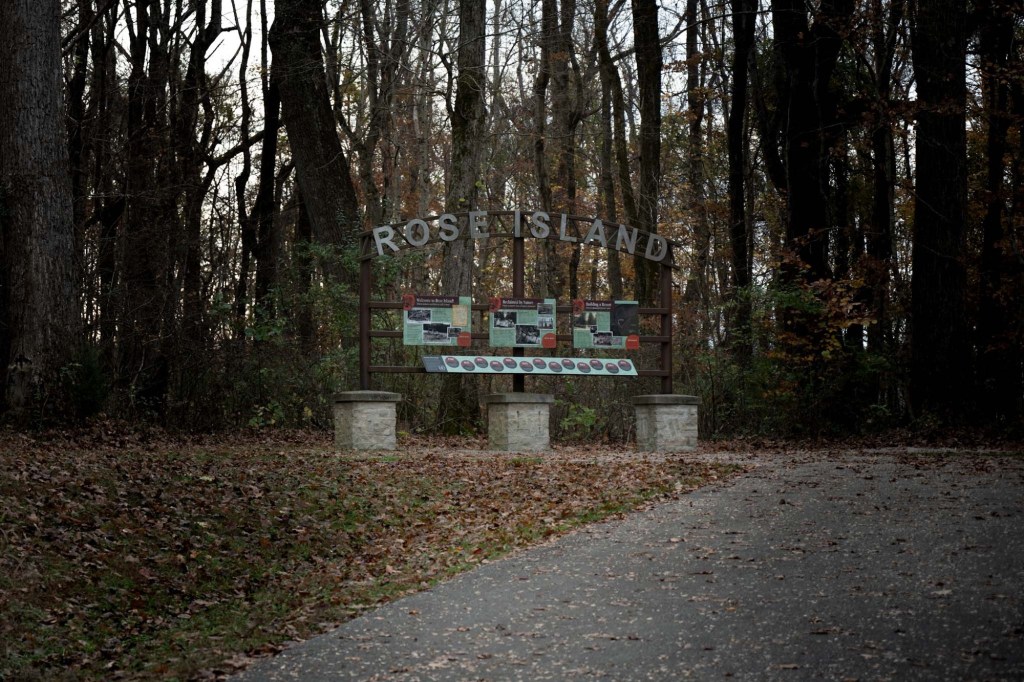
When we arrived, we followed the signs back through the park toward Rose Island, then parked at the trailhead. The Rose Island Trail is a small loop attached to the larger loop Trail 3, which begins with a 200 foot descent down a paved road which granted us glimpses of the river through the trees as we wound our way down. On the other side of the river is Kentucky. And once we’ve finished our descent, there, on the other side of Fourteen Mile Creek, is Rose Island.
An IndyStar article from 2018 gives us a little more information about the peninsula. Initially known as Fern Grove, it was a destination with a marketing team: In 1881, when railroads were undercutting steamboat interests, a company with a surplus of boats and not enough goods to move bought the land in order to sell passage for day trips. It changed hands in 1923, and the new owner changed the name, expanded it, and added amenities like the amusement park. In its heyday, Rose Island is said to have welcomed 135,000 guests annually.

The end of that decade heralded the beginning of the Great Depression, yet the park stayed open and continued to receive visitors, though the admission fee was cut significantly. In 1937, however, the Ohio River’s catastrophic flood was bad enough to shut it down for good. According to the National Weather Service, record rainfall over a twelve-day period that January- which remains the wettest month on record in Cincinnati to this day- led to unprecedented flooding from Huntington, West Virginia, all the way to its confluence with the Mississippi in Illinois, a good two-thirds of its nearly thousand mile length.
Rose Island, along with countless other sites along the river’s length, was ravaged. Most everything was swept away, and the little left was not much more than some pillars and miscellaneous stone ruins- and the swimming pool, a formerly filtered wonder turned breeding ground for mosquitoes. It was eventually drained and filled with gravel to prevent recurrence, and so it remains today. The ladders into the pool, still intact, stand with their top two rungs above the gravel, as if one could climb back in. An information board nearby shows an array of historical advertisements for the park from its active years.

There is much more history that extends ever further back. A handful of miles further west down the river is Clarksville, the first American settlement in the Northwest Territory- north and west of the Ohio River, that is- named for George Rogers Clark, known for his Revolutionary War exploits, and his little brother of Lewis and Clark fame. The county is named after him, too.
If we go back another hundred years, some maps of French trappers had already defined the Great Lakes and Mississippi and Ohio Rivers.
And before that? Well. History is so staggeringly long that European occupation has occurred in the blink of an eye, though it has been frighteningly complete. This topic, however, deserves its own space rather than a footnote. For now, suffice it to remember that though the name may sound accommodating enough to native people, there are no federally recognized tribes left in the state of Indiana.

We passed through a set of arches that once welcomed visitors to the park, where socialites of the last century’s Roaring Twenties and Tumultuous Thirties may have hoped to luxuriate their woes away. Eventually, we turned back toward Trail 3, which follows Fourteen Mile Creek for a while longer before meandering back around to the left to complete the loop. The water was quiet, and so were the woods. A few chickadees hopped around, and a cardinal was a sudden flash of color. A jay nearby expressed its displeasure at our proximity. Which was fitting, as perhaps proximity should be the theme of this place. That of nature, which is always there with its so many intricate layers, even when it sleeps. And likewise, that of history, with lifetimes compressed together like strata. Though our short hike only showed us a small part of the park, it has definitely given me a lot to think about.

Leave a comment