I’ve noticed while working on my catalog that I have a lot of images of birds. The easy reason is that I snap a lot of bird pictures; these ubiquitous flying dinosaur descendants are often cool looking, fun to watch, and many of them stick around when all the other animals have gone for the season. They can also present all kinds of fun challenges: Tiny chickadees and sparrows flitting through branches are rarely willing to hold for a portrait, for example, while creepers and the like seem to cast invisibility as you walk by. Their mastery of the air, too, can mean that the photoshoot is over long before you wish.
That implies that there’s a not-so-easy answer, and of course there is. It’s been joked that interest in birding is a sign of impending old age and maybe it’s true: I wasn’t long into my thirties when I felt the need to start collecting bird sightings as if they were Pokémon. But I can actually pinpoint the exact moment I got sucked into the birding trap, and it wasn’t a birthday. It was a cryptid encounter.
While hiking at Prophetstown State Park in West Lafayette, Indiana in early spring 2019, a bird happened to catch my eye. I now recognize it easily as a White-breasted Nuthatch, known for its antics and acrobatics, but back then this baffling gravity-defying bird was surprising, not least when it first popped out from behind a tree at me from a fully horizontal position. I watched it for a while, and couldn’t help but snapping a series of photos of the charismatic little lunatic.

Then I noticed another bird perched nearby. This one wasn’t so keen to pose for me and took off quickly, but not so quickly that I didn’t get a shot first that led me on what felt then like a quest for Bigfoot. To my inexperienced eye, it didn’t quite seem to match anything. The closest was a Belted Kingfisher (spoiler alert: it is), but their description as blue and white versus its appearance as black and white confused me, not to mention that its comically large head and beak- notable even for these guys- gave me pause against the reference photos. Perhaps it was a juvenile, or maybe strange perspective was fooling me as much as the lighting did.
With experience I can look back and say that it’s absolutely a kingfisher, and maybe the kingfisheriest one to ever grace a tree branch. Google Lens can identify the image in a second or so now, too. (And correctly, though that’s not always a given: Once it assured me that a flock of Sandhill Cranes in flight that I’d photographed was actually rogue pterosaurs. While it would have been awesome for the portfolio, I’m disappointed to report that it was inaccurate.) At that time, though, I had no recourse but to flip page-by-page through my field guide of birds and compare every single one to Bigbeak. No match. It seemed I had a mystery.

By the time I eventually figured out who my mystery bird was, I’d already looked at the thousand other possibilities in North America time and time again. The trap had been sprung and I’m hooked. I wanted to see all these other birds, but that kingfisher was something special.
I had to find another and get a better picture, but they were secretive birds and didn’t make it easy. I learned that they would often be found on branches overlooking water as they wait to prey on fish swimming by. Always alert, though, they would quickly fly off when approached. As silent as they may be on their perches, their call with its machine-gun tempo startles and jars when they take to the air. And then they’re gone, with the sound fading like a mocking laugh.
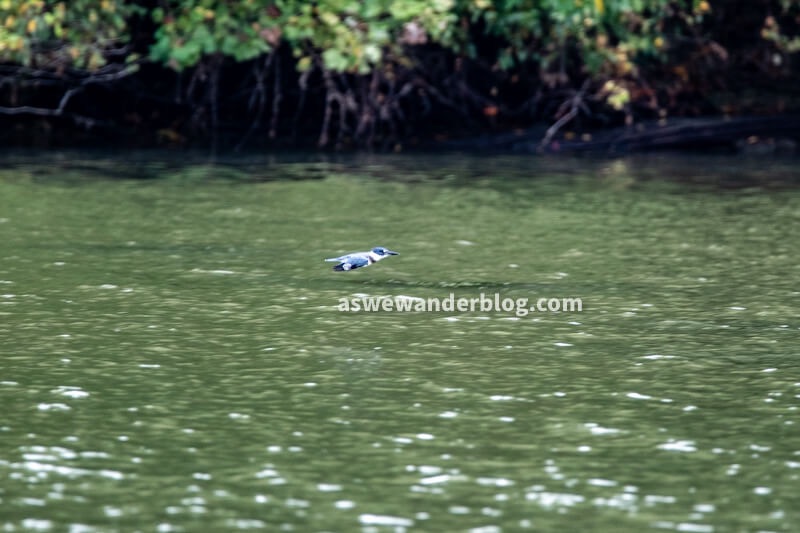
Over time I got better at spotting them, and with my eyes on the trees I marked off scores of other birds too. Sometimes I’d get a distant picture of my coveted Bigbeak kingfisher, or a blurry one: A bright white spot between their eye and beak always confuses the camera and leaves me feeling all the more like I’m chasing Bigfoot.
But little by little I’d get closer. I learned to hear its chatter from a riverbank, and would know then that one was in motion; quickly, then, to scan and get into position. That sound is the pistons running their wings; they rarely fly in silence. Once the noise stops, they are still.
Finally at the end of January, I found myself chasing one down the banks of frozen White River only a short distance from home, and my glorious cryptid bird finally took pity and stopped to give me a smile.
After a while it flew off, but I was content. After nearly six years of trying, my lens and I had finally captured the eye of the beautiful Belted Kingfisher.
I headed back down the riverbank toward my Jeep and stopped obligingly when I heard a chirp above me to snap a few shots of the Northern Cardinal perched overhead. The scarlet males are instantly recognizable to most people in their range, but are often ignored because they’re common- though arguably so is my kingfisher, who just hides a little better.

The cardinal didn’t really care if it got its picture taken or not, of course, but it’s fun to imagine that it did. Walking on, I neared the river access where I’d parked, and glimpsed another flash of color out of the corner of my eye- this one blue.
There was the kingfisher, calmly perched as if it were waiting for me. I still had the camera in hand, of course, so we shared a final moment before going our separate ways.
Too often, the stories of awesome nature encounters hinge on large mammals and/or remote locations, and I’m just as guilty of this as anyone else. Those stories often are pretty cool, sure; but there’s so much more that requires so much less. This is my ode to the bird at my local riverbank, much more impressive to me than some of the more dramatic animals I’ve had the opportunity to photograph.
I wouldn’t dream of putting anybody through the countless Bigfoot-quality pictures I took, but I collected the best dozen or so- including that prized final image, which yes, I so rudely withheld- in the Quest for the Kingfisher gallery. Check it out!


Leave a comment