What is the gayest animal on earth?
I presented this question yesterday for two reasons. The easy explanation is that it was a fun way to introduce this next animal, but I was also interested in gaining some insight into people’s perceptions.
Answers that I received included bonobos, dogs, dolphins, ducks, eagles, flamingos, penguins, people, unspecified insects, and wolves. These are all correct to some degree, but only one can reach the pinnacle and it’s none of those.
It’s a high bar indeed.
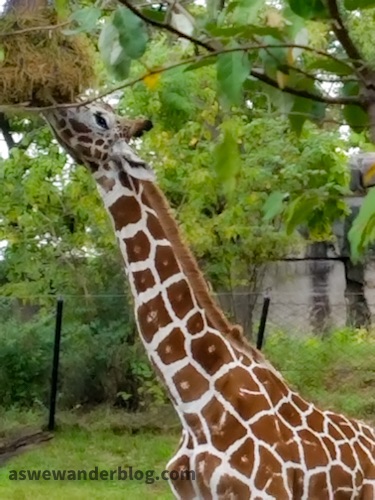
The answer, surprising as it may be, is actually the giraffe. Is it because of their impeccable style or the way they sashay across the savannah? No, that’s a stereotype. It’s the fact that the overwhelming majority of their couplings are between the males.
They do dress pretty sharp, though.
While admittedly a niche subject, giraffe sexuality is intriguing not just due to the larger discussion, but there’s also some interesting history involved. Canadian zoologist Anne Innis Dagg traveled alone to apartheid-era South Africa and began her study of the giraffe in 1956, becoming the first western scientist to study African mammals in the wild. At this time she also began only the second extended study in the world of any mammal, four years before Jane Goodall arrived in Africa to begin her primate studies.
While arranging the details prior to her travel Innis Dagg had to sign her messages ambiguously out of concern that as a woman, she would not be allowed to conduct the study. And when the omission was discovered that crisis nearly happened, but with persistence and her foot already in the door she was eventually able to get her necessary approvals regardless.
Her first paper on giraffes was published in 1958. It was notable not only as the first scientific study published on African mammals or because of its trailblazing author, but she also rejected the standard practice of explaining away anything that went outside the norm. She didn’t go looking for gay giraffes, but that’s what she got. And she reported it faithfully.
Researchers at the time were quick to explain away any observed same-sex sexual interactions- a practice which has not yet been fully abandoned- and various hypotheses are presented to explain the behaviors including asserting dominance, confusion, and practice. Yes, practice. Same-sex behaviors noted in fruit flies in a 1988 study were explained to be courtship practice from the point of view of the passive male (though I must admit I don’t quite follow the logic).
Well, considering that an estimated 90-94% of giraffe sex is homosexual, they’re getting lots of practice for when that fabled time finally comes.

Innis Dagg’s 34-page paper, The Behaviour of the Giraffe, Giraffa Camelopardalis, in the Eastern Transvaal, doesn’t focus solely on sexuality; the subject doesn’t even appear until page fourteen and then only covers about two pages, leaving the rest of the paper focused on other attributes. But over those couple pages, she dropped several bombshells.
“Courting behaviour in the giraffe was relatively rare— far rarer than mounting and sexual play among the males… Homosexual behaviour is much more in evidence than heterosexual behaviour. Even when females are present in a herd, the males often gather together apart from them and neck and mount each other.”
Just as telling is the comment she makes regarding a heterosexual coupling she witnessed: “This one case was the only time I have seen giraffe mating.”
Studies by other researchers have had similar results: two multi-year studies conducted in the 1970s reported no observed instances at all, and in a 1985 study, over 3200 hours of field observation resulted in a single observation.
Innis Dagg continued her work, publishing several books and around sixty academic papers before her death last year at age 91. Though sexuality was a side note in the study that began it all, another groundbreaking work that she published in 1984 focused on it directly: After analyzing 125 different species of mammals, she found homosexual behavior to have widespread occurrence.
As can be expected since some people still struggle with that concept today, controversy ensued. Much of the argument was in the academic sphere- along the lines of aggression! Ok, then why foreplay?– but it also caused debate among the public. One particular incident from 2019 stands out, and the first line of this article from The Guardian is too good to not share.
“A new split has emerged in the Labour party over a matter more urgent than Brexit: the sexuality of giraffes.”
Politicians arguing is no new thing, but the statement that spurred this article is amusing and also worth examining. The article quotes a speech by British politician Dawn Butler in which she says “ninety percent of giraffes are gay.” The fuller statement reads:
“They talk about teaching people or children to be gay. They don’t want people taught to be gay. I want to know this, right: if you can teach gayness- if that’s even a word- if you can teach gayness, who speaks giraffe? Because 90% of giraffes are gay. So, if you can teach it, I want to know who the hell speaks giraffe?”
A fellow politician retorted that the statement was offensive and homophobic and that giraffes absolutely only exhibit dominance behavior. And that, by the way, they’re his favorite animal.

I’m not even going to try to unpack that reply. But I will make a note on the semantics used in the first statement. Are 90% of giraffes gay? We don’t know. We can’t know, unless someone does learn how to speak giraffe and starts doing a whole bunch of surveys about their feelings toward other giraffes. Until then, we can only measure behaviors, which is where those high percentages come in. So no, we don’t know what percentage of giraffe individuals are gay.
But we do know that overall, they have a ton of gay sex.
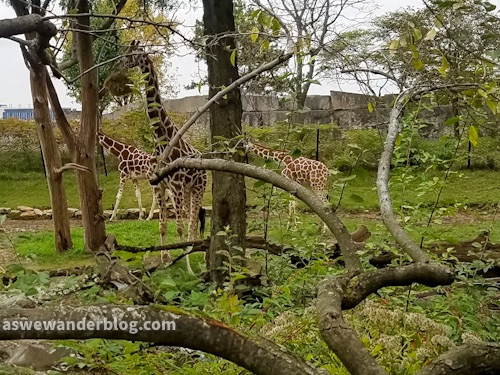
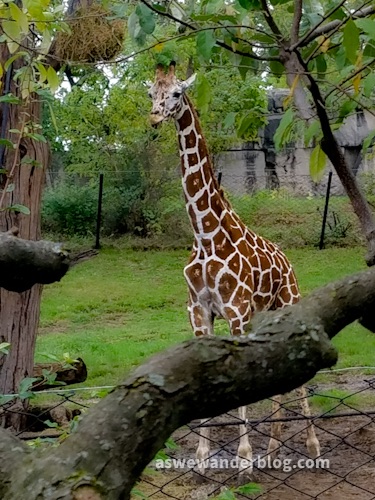
Pictured: Captive Reticulated Giraffes at the Indianapolis Zoo, October 2017.


Leave a comment