When the British expeditionary ship Terra Nova reached Antarctica during the race for the South Pole in the early 1900s, explorer Apsley Cherry-Garrard made an amused notation on their reception by the local Adélie Penguins which he later described in his book, The Worst Journey in the World. He wrote:
They are extraordinarily like children, these little people of the Antarctic world, either like children or like old men, full of their own importance and late for dinner, in their black tail-coats and white shirt-fronts- and rather portly withal. We used to sing to them, as they to us, and you might often see “a group of explorers on the poop [deck], singing ‘she has rings on her fingers and bells on her toes, and she shall have music wherever she goes’ and so on at the top of their voices to an admiring group of Adélie penguins.”
Cherry-Garrard later found himself spending part of an Antarctic winter in the rookery of a different tuxedoed bird, the Emperor Penguin, “on the weirdest bird’s-nesting expedition that has ever been or ever will be,” after 19 so-called “days” of travel in which he and two companions pulled sledges across frozen terrain full of hidden crevasses during the endless winter night. They faced temperatures that make sub-zero sound balmy, multi-day blizzards, and wind that could freeze them to the spot- all to study the birds and collect some eggs for research.
So heed the warning, folks, and be careful. Birds are clearly a gateway drug. We relate so easily to these bipedal derps, and this is no new thing. They’ve been intriguing people forever. Ornithomancy- the practice of reading omens from bird behavior- dates back to at least Ancient Rome, and Charles Darwin famously used his observations of Galapagos finches to help develop his theories of evolution.
not-quite-a-penguin will have to suffice.
The Terra Nova’s crew did not win the race to the pole- that honor instead went to legendary Norwegian Captain Roald Amundsen. Yet the expedition has had a lasting impact regardless, adding to the body of scientific knowledge in several fields- including, most notably for us, biology and zoology.
While Cherry-Garrard’s team focused on Emperor Penguins, another group led by his shipmate Dr. George Murray Levick spent the better part of a year studying the Adélies, including about three months amidst them recording daily observations in what would later be learned to be their largest colony in the world. His findings were published in 1915 as Natural History of the Adélie Penguin– but it was nearly a century later that a significant omission was discovered. A section on sexuality had been suppressed with only few copies printed, and in 2012 one of those pamphlets was discovered tucked inside another work in the English Natural History Museum and authenticated.
Throughout the larger work on Adélies, Levick referred to groups of “hooligan cocks” multiple times, though explanation of why he named them so remained vague. Some of their behaviors he found to be so shocking that he felt compelled to cipher those notes in the Greek alphabet in his field observations. Once the pamphlet was discovered and these notes clarified, some of these observations did turn out to be pretty unsavory, with instances of behaviors such as necrophilia; yet Levick’s morality appeared to be just as offended by occurrences of homosexual and even non-procreative heterosexual sex between the penguins. In what is now known to be the first scientific observation of homosexual behavior in animals, he wrote,
Here on one occasion I saw what I took to be a cock copulating with a hen. When he had finished, however, and got off, the apparent hen turned out to be a cock, and the act was again performed with their positions reversed, the original “hen” climbing on to the back of the original cock, whereupon the nature of their proceeding was disclosed.
Yet as this work was not yet on the public radar, another contender for the first account appeared. In 1923, Scottish ornithologist John Ritchie photographed a nesting pair of mute swans and thought little of it until noticing that the nest had no eggs. After a few encounters with the birds- and still no young- he realized with closer observation that they were pair-bonded males. When he submitted the photo and analysis to the local scientific community, it was explained away- as still happens a century later- with the journal’s editor suggesting that it must be a heterosexual pairing in which the female simply had masculine features.

Indiana, March 2025
The subject continued to be widely taboo when Anne Innis Dagg worked on her giraffe studies in the latter half of the 1950s, and tensions over gay rights were rising throughout the country. Homosexuality was a criminal offense in many places and non-conforming people were widely harassed and arrested; gay bars operated like speakeasies and were often raided, and gay people would often be refused service elsewhere. Clashes began in the mid-1950s, but it was the Stonewall Uprising in late June 1969 that grabbed headlines and became the major catalyst for the LGBTQ+ movement.
The Stonewall Inn, a Mafia-owned dive in New York City’s Greenwich Village where the eponymous events took place, was a particularly well-known gay bar and got raided about once a month- that is, until enough was enough and the people fought back. Several days of protest and resistance followed while the local police tried to tear gas, arrest, and/ or stomp them into compliance.
Compliance was not achieved.
The following June brought a commemoration which is now seen as the first Pride parade, and in late 1973 the American Psychiatric Association decided to no longer list homosexuality as a mental illness. But while a step in the right direction, it wasn’t enough.

South Carolina, June 2023
In 1977, while ABBA’s Dancing Queen was dancing around the top of the pop charts, controversy was still raging. Openly gay Harvey Milk was elected to a seat on the San Francisco Board of Supervisors, though he would be assassinated a year later; meanwhile, Southern Baptist singer and homophobe Anita Bryant led a successful campaign to revoke a gay rights ordinance in Dade County, Florida, leaving the Miami gay community in limbo for 20 more years.
It sounds irrelevant to add that a pair of researchers released a paper on Western Gulls that year, too. What do flying French fry thieves have to do with anything?
A Washington Post article from December 4, 1977, reported:
A research team from the University of California at Irvine announced last week that 14 per cent of the seagulls on Santa Barbara Island, 40 miles from Los Angeles, are gay. Naturally, everyone else in the country is going around saying, “That’s California for you.”
Then an unidentified citizens task force in New York counter-announced in The New York Daily News that 100 per cent of the seagulls in [the] five boroughs of New York are strictly heterosexual. Nobody asked them, but, then, that’s New York for you.
-Judith Martin, “Science and the Gay Gull”
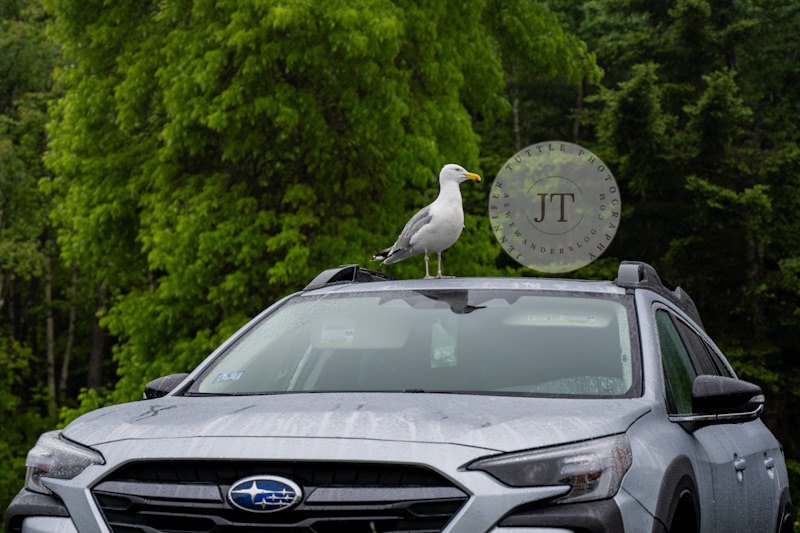
Maine, June 2025
These scientists, married couple George and Mary Hunt, spent three years studying the gulls and noticed that some nests held more eggs than expected. Eventually they determined that these nests belonged to pair-bonded female gulls, many of which were successfully raising chicks together. With Levick’s penguin report still suppressed, Ritchie’s swan photograph ignored, and Innis Dagg’s giraffe shenanigans being widely shrugged off as snuggly dominance behavior, this report- Female-Female Pairing in Western Gulls (Larus occidentalis) in Southern California– landed heavily into the middle of all of the ongoing controversy.
Dominance behavior be damned, these birds are in love.
Too late to spin it, the damage control options seemed to be wearing thin for the homophobic right. But outrage was still a workable tactic, so this study, scorned simultaneously as frivolous and depraved, ignited a furor which went as far as to delay the National Science Foundation’s budget review and renewal for having partially funded the work.
Yet the Hunts received more than just vitriol in response, as some members of the beleaguered LGBTQ+ community also reached out to express support and appreciation for the work, and letters also began to trickle in from farmers who had noticed some similar behaviors in livestock over the years. With the Hunts’ research firmly in place and the echoes of Stonewall still reverberating, the stage was set for study to continue.
In the half-century that has passed since the gull publication, scientists have continued to observe non-heteronormative behavior and/ or bodies in various species: Though birds formed the basis for most of these earliest reports, examples have been discovered across the animal kingdom. But while the existence of queer animals has become more accepted, the research still raises eyebrows.

Indiana, June 2024
While I can’t answer for anybody else’s motivations in studying queer animals- for the same reason that I won’t say “yup, that giraffe is absolutely gay,”- I can reiterate my reasons for writing about them. This isn’t about kink-shaming critters, nor does my enjoyment of the subject surpass intellectual curiosity. I’m just as happy to look up other things. But sexuality is an aspect of theirs, just as much as it is ours as humans, and perhaps in learning to understand it, we can also begin to understand and accept ourselves.
While I dream of changing hard-headed people’s minds (don’t we all?) I’ve had a different audience in mind with these articles. To the person reading this who is still in the closet and afraid, or who wishes they were but no closet can hide them: I’m writing these for you.
No matter how scary the world gets, you are not unnatural, and you are not alone.


Leave a comment