When we see things often enough, we tend to stop noticing them. It’s not laziness, but a manner of managing attention resources so that they’re available for more important input. People notice this phenomenon most after driving a familiar route and then realizing that they’ve forgotten half of it, but there’s all kinds of other things we overlook. That pile of junk mail on the counter, or that squirrel in the yard- that is, assuming that you don’t have a dog who makes sure to alert you of each one. In such a world, what could be more mundane than a sparrow?
When John James Audubon- for whom the ornithological society is named- painted a pair of White-throated Sparrows in 1827, he probably didn’t have junk mail on his counter, though he may or may not have had a dog that barked at squirrels. But he did make a mistake in assuming that this bird was ordinary, labeling the brighter-colored bird with a white stripe on its head as a male, and the more muted one with a drab tan stripe as female.
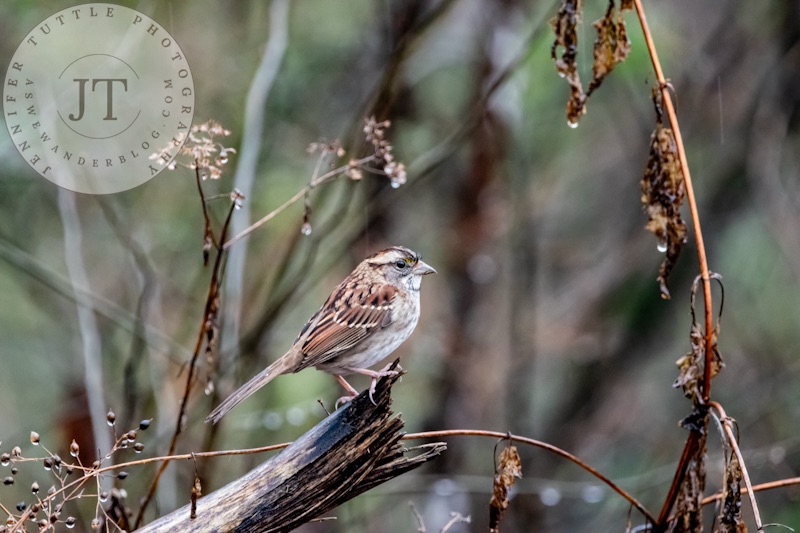
In many cases, that would be a reasonable inference. Sexual dichromatism was mentioned a few days ago in reference to Brown-headed Cowbirds but it’s not a unique trait to them by any means. Nor was Audubon’s guess necessarily out-of-line considering that in most dichromatic species, the brighter colors are worn by the males. (Don’t tell the giraffes.)
Audubon could have also been reassured by the fact that the brighter white-striped sparrows exhibit more stereotypically masculine behavior and the tan-striped ones more stereotypically feminine. Pair-bonding predominantly occurs across these groups as well.
But beyond this point, the pattern suddenly falls to pieces.
Perhaps you find a nest like the one that Audubon presumably saw. The drab one settles into the nest while the bright one is singing away interlopers with its rockin’ rhythmic song. If not too distracted by territory concerns, Flashy Bird may feed the chicks sometimes, too, though maybe not.
Yet perhaps the next nest over has a brightly-colored sparrow laying eggs while her drab mate fusses around. Especially in areas with higher population density, the Bird Next Door is likely to provision the nest more often than the easily-distractible Flashy Bird, though when its song more rarely bursts forth, it lacks the polish of Flashy Bird’s.
The birds in the nests create even more confusion. There’s a Flashy Bird and a Bird Next Door, but they’re both laying eggs. They feed the young at similar rates, but Nesting Flashy Bird sings more and behaves more aggressively than Nesting Bird Next Door.
What was going on with these birds?
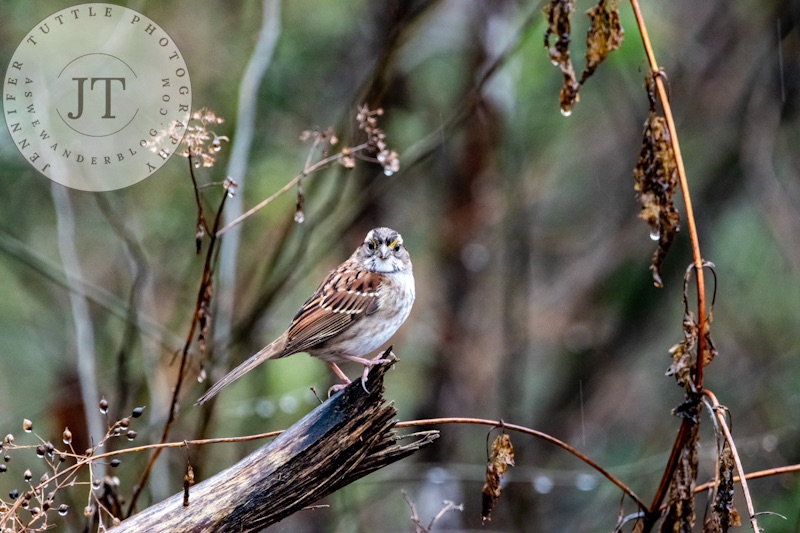
Eventually science caught up- though in answering one question, many others appear. DNA studies have shown an extensive chromosomal inversion in these birds, as if at some point a strand was snipped and flipped, effectively beginning the evolution of a second set of sex chromosomes. This results in their reproductive behaviors co-varying with their plumage, but independently of their sex, resulting in four distinct groups: white-stripe morph females, white-stripe morph males, tan-stripe morph females, and- good job, you guessed it- tan-stripe morph males.
So does this bird have four genders? Sounds like an easy yes, but that’s not something we can determine. It would be closer to say that they have four sexes. Though related and often used synonymously, gender and sex are different concepts, with the former relating to identity while the later refers to physical characteristics.
When considering that difference, I’m reminded of an exchange from a few years ago while I was studying forensic anthropology. Maybe it can make the distinction stick.
-How do you [determine the] gender [of] a skeleton?
-You don’t. Gender identity can’t be determined via physical remains.
-Ok, fine. How do you sex a skeleton?
-Try taking it to dinner first.
Hope that helps.


Leave a reply to Dolphin Nonsense – As We Wander Cancel reply